How to Choose a Wedding Caterer: Questions to Ask
Food and drink are usually the largest line in a wedding budget. How to compare caterers, what to taste, what to ask, how to read the contract and where the honest savings are.
Most couples spend more on feeding their guests than on anything else, and the caterer is the vendor guests experience most directly: every plate, every drink, every server who refills a glass or doesn’t. In The Knot’s 2026 Real Weddings Study, which surveyed more than 10,000 couples married in 2025, 85 percent hired a caterer, and overall spending averaged $292 per guest for the whole wedding. Food and drink account for a large share of that, which is why choosing a caterer well, and reading the proposal carefully, matters so much.
Start with the venue
Before you compare menus, find out what your venue allows.
In-house catering. Hotels, clubs and many event spaces cook their own food and do not allow outside caterers. You choose from their menus, and the venue fee and catering are often combined in a per-person price.
Approved lists. Some venues require you to choose from a short list of caterers who know the kitchen and carry the right insurance.
Open venues. Barns, gardens, private homes, museums and lofts may let you bring any licensed caterer, but may have no kitchen, limited power or no running water. The caterer then brings everything, and the rentals bill grows.
Ask an off-site caterer to visit the venue before quoting. Indoors or outdoors, the menu has to be held hot or cold, plated and served from wherever the kitchen ends up.
Service styles
Plated. Each course is plated in the kitchen and served to seated guests. Formal and well-paced, but it needs more staff and usually means guests choose an entrée in advance with their RSVP.
Buffet. Guests serve themselves from long tables. Offers variety and suits relaxed weddings; it needs space, takes time for a large crowd and is not always cheaper, because caterers make more food to keep platters full.
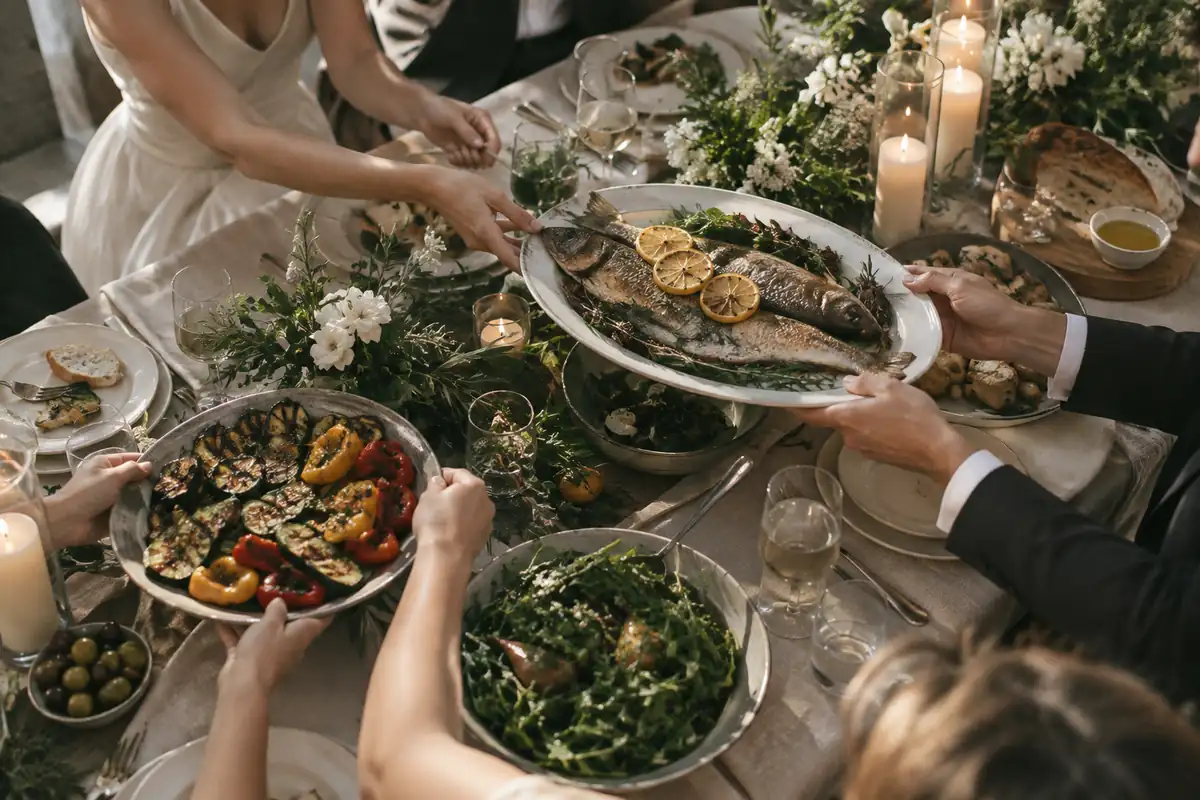
Family style. Platters and bowls are set on each table and passed. Generous and convivial; it needs larger tables and more serving pieces.
Stations. Chefs serve from several stations, such as carving, pasta or tacos. Lively, encourages mingling, and often costs as much as a seated dinner.
Cocktail reception. Passed and stationary hors d’oeuvres instead of a full meal. Elegant and flexible, but there must be enough food that nobody leaves hungry; tell guests on the invitation or website what to expect.
For more on building the menu itself, see our guide to the wedding menu.
The tasting
Ask whether a tasting is included, what it costs if not and how many people can come. Tastings are expensive for caterers, so don’t assume you can bring both families. Some caterers hold group tastings for several couples; others offer one only after you book.
Taste for flavor and seasoning, but also ask how each dish holds and travels. Food cooked for four in a test kitchen behaves differently from food cooked for 150 in a tent. Ask to see photographs of the same dishes at real events, and if you can, look in at a wedding the caterer is serving.
Questions to ask
Availability and experience. Are you free on our date? How many weddings do you cater a year? Have you worked at our venue? What is the largest event you have handled, and how many events do you staff on the same day?
Licenses and insurance. Are you licensed and insured, including liquor liability if you serve alcohol? Many venues require a certificate of insurance.
Staffing. How many servers, bartenders and kitchen staff will we have, and who is the on-site captain? A common rule of thumb is more staff for plated service than for a buffet; get the numbers in writing rather than trusting a phrase like “fully staffed.” What will the staff wear?
Food. Do you cook from scratch? Who makes the bread and desserts? Can you customize the menu, and how far in advance must it be final?
Bar. Do you supply the alcohol, or can we? Is there a corkage fee for our own wine? Do you provide bartenders, ice, glassware and a champagne pour for the toasts?
Rentals. What is included (tables, chairs, linens, china, glassware, flatware) and what must be rented? Can we see samples? Who orders and returns them?
Cake and dessert. Is cake cutting included, and is there a fee for a cake from an outside baker? Our wedding cake guide covers what to ask the baker.
Vendor meals. Do you offer meals for the photographer, DJ and planner, and at what price?
Timing. How many hours of service are included, does set-up and clean-up count, and what is the overtime rate?
Leftovers. What happens to leftover food? Many caterers will not release it for food-safety reasons, but many will pack a plate for the couple, who often barely eat.
Dietary needs and allergies
Collect dietary needs with your RSVPs and pass the list to the caterer with each guest’s name and table. Ask how the kitchen handles serious allergies: separate preparation, labeled buffet dishes and servers who know the ingredients. Place cards marked discreetly for each guest’s meal help servers get the right plate to the right seat. Vegetarian and vegan dishes should be as considered as the main menu, not an afterthought. For kosher, halal or other religious requirements, ask whether the caterer is certified or works with a certified kitchen.
Reading the contract
Get a written proposal from each caterer, then a contract from the one you choose. It should state:
- the date, times, locations and hours of service
- the menu, service style and number of courses
- the staffing numbers, by role
- the price per guest, and every additional charge: rentals, bar, cake cutting, corkage, travel, service charge, tax
- the guaranteed minimum, and the date the final guest count is due (often a couple of weeks before)
- the deposit, payment schedule and the date of the final payment
- the cancellation and rescheduling policy, including what happens to the deposit
- the name of the person in charge on the day
Read every line before signing, and keep the final guest count deadline in your 12-month planning checklist.
Service charge versus gratuity
This line causes more confusion than any other. A service charge is a mandatory fee, often a percentage of the food and beverage total. It may cover administration, equipment or staff wages, and it may or may not reach the people serving your dinner. The IRS treats a charge a business adds automatically as a service charge rather than a tip (Revenue Ruling 2012-18).
A gratuity is a voluntary tip, which you decide on. Ask your caterer directly: what does the service charge cover, does any of it go to the servers and bartenders, and is gratuity expected on top? If the service charge goes to the house, plan cash tips for the staff, given to the captain in an envelope at the end of the night.
How to save on catering
Choose the time of day. Guests expect a full meal at dinnertime. A late-morning brunch or lunch, an afternoon tea or cake-and-champagne reception, or a late-evening hors d’oeuvres and dessert reception can cost much less and still feel abundant. Say what to expect on the invitation or website, for example “Cocktails and hors d’oeuvres to follow,” so nobody arrives hungry.
Trim the guest list. Every name has a per-guest cost; our guest list guide shows where to draw the line.
Simplify the menu. Two or three courses rather than four, seasonal ingredients, chicken or vegetarian mains rather than beef or seafood, and one excellent dessert.
Limit the bar. Beer, wine and a signature cocktail cost less than a full open bar. If your venue allows it, buying your own wine and paying corkage can save money.
Watch rentals and hours. Standard rentals cost less than specialty ones, and a shorter reception means fewer staff hours. Ask the caterer to begin clearing quietly while guests are still dancing.
Build the savings into your wedding budget from the start, and choose the caterer whose food you loved, whose staff answered your questions clearly, and whose numbers added up.
Written and edited by the Today’s Weddings editors. How we research and check what we publish is set out in our editorial standards. Spotted something wrong? Tell us.